
Claude Code is Crack Cocaine
The Instagramming of Work and the Death of Deep Work

In 2021, I sat in front of a camera to talk about the sanctity of the “One Horse.” I was a disciple of Cal Newport, preaching the gospel of Deep Work—the idea that to produce anything of value, you have to shield yourself from the “monkey mind” of multitasking. At Launchable, we built an entire culture around “Get Shit Done” (GSD) days, creating organizational umbrellas to protect our cognitive sovereignty.
I thought I had mastered the “horses running all over the place.” I was wrong.
In late 2025, I dove into Claude Code. I lucked out on the timing; the models had just hit a threshold of capability where the vibe of building shifted from collaborating to orchestrating. It felt like I had finally found the ultimate GSD weapon.
But within weeks, the “One Horse” was trampled by a stampede.
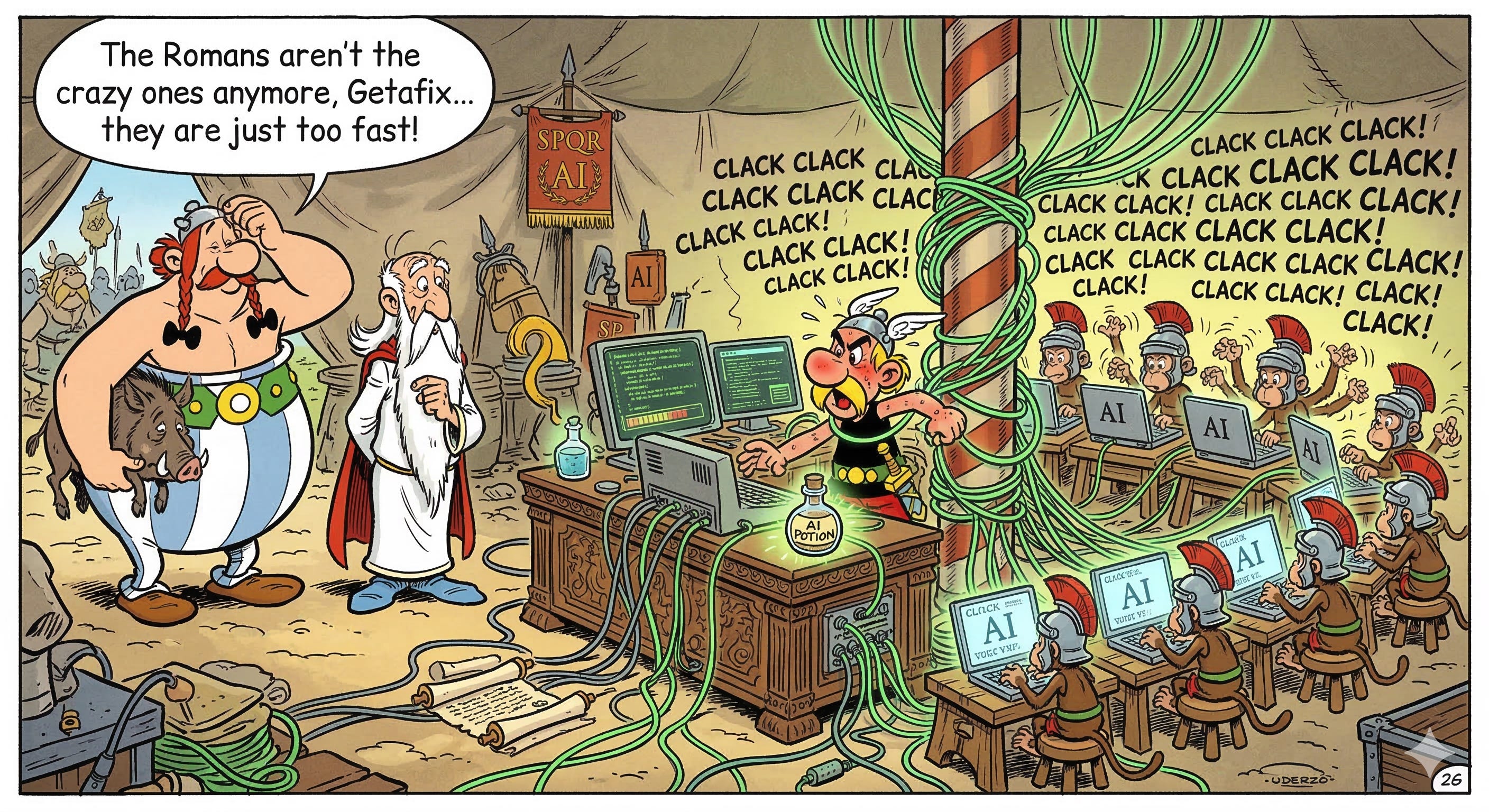
The Infinite Monkey Circus
The industry is currently obsessed with building the “harness.” Whether it’s Steve Yegge’s Gastown, the Agentic Flywheel, or the various frameworks designed to keep AI agents on track, we are all trying to build a better circus. I’ve spent the last few months immersed in these systems, writing about how they work and, more importantly, trying to use them to build.
The promise is intoxicating: an Infinite Monkey Circus where you are the Director. You provide the vision, and the agents provide the relentless, 24/7 labor. But here is the reality of being the Director: you are still the one holding the whip.
I’ve reached a point where I am running 3–4 parallel projects, each powered by a swarm of 4–5 agents. I am using the most sophisticated harnesses available to keep the monkeys performing, but I’ve inadvertently tied myself to the center pole. These agents provide incredible volume, but they demand a constant, high-intensity cognitive presence to stay on the tightrope.
I am no longer the “visionary architect” I set out to be; I am the AI Babysitter. I am a vital component in the system, providing the one thing the harnesses can’t yet automate: the “ground truth” and the sense of direction. Because the monkeys are so fast, the feedback loop is instantaneous. If I look away for even two minutes, the momentum stalls or the circus falls apart.
Cognitive Redlining
This brings me to the physical and mental cost: Cognitive Redlining. Steve Yegge describes this perfectly. Your brain is an engine built for a certain speed, but working with Claude Code is like redlining that engine at 9,000 RPM for twelve hours straight. You aren’t “coding” in the traditional sense; you are making high-stakes decisions every ten seconds.
The physical implications are wild. I find myself standing at my desk for hours at a time, afraid to sit down because the “payout” is always imminent. If I do step away to the couch, I’m rarely there for more than two minutes before the itch pulls me back.
Even my walks—the ultimate staple of the Deep Work lifestyle—have been ruined. I’m no longer “present.” I am mentally tethered to the terminal, hurriedly trying to get back because I know Claude is likely waiting to ask me a question. The “AI baby” is hungry, and I’m the only one who can feed it. By the time I finally disconnect, the crash is absolute. I wake up the next morning in a depleted state, my mental battery at 5% before the day has even begun.
The Instagramming of Work
This is where the behavior mirrors my struggle with Instagram, but with a devious twist.
We all know the “doom scroll.” You’re on Instagram, your thumb is moving, and the hours are vanishing. There is an inherent understanding in that moment: you have surrendered your mental energy to the vampire. It feels bad. You feel the “waste,” and that guilt is usually the only thing that eventually makes you put the phone away.
With Claude, the behavior is identical—the dopamine hits, the variable rewards, the inability to look away—but the guilt is gone.
I tell myself, “Hey, I’m working. I’m being a conscientious builder.” This is the Instagramming of Work. We’ve taken the addictive engineering of social media and dressed it up in a suit and tie. Because the output is “productive,” we have no internal defense mechanism. We are “Vibe Coding,” and as long as the progress looks fast, we ignore the fact that our cognitive sovereignty is being harvested.
What’s worse? Even when the “vibes” are rancid—when I’m struggling with a wrong implementation or an agent is hallucinating in a loop—I still can’t leave. I keep pulling the lever, desperate for the next hit of a working fix. I’ve reached a place where the reward of the “fix” is so good it overrides my physical need to rest.
The Final Warning
I reached a point where I realized my brain was legit fried by the end of every day. My solution, ironically, was more AI. I learned how to build a Director Claude agent—a harness aide designed to sit above the others and respond on my behalf. I thought if I could just automate the “Director” role, I could finally take that walk without looking over my shoulder.
It didn’t work. The Director agent still comes back to me “ever so often.” And in this high-velocity world, “ever so often” is enough to keep the tether tight.
To my fellow conscientious builders: we need to look at what we are actually building. If the price of a “10x” output is the total extraction of our mental and physical well-being, is it a fair trade?
I am still in the loop. I am writing this very post while Claude is running in another window, moving my product development forward. I literally couldn’t leave the desk to write about why I can’t leave the desk.
The “One Horse” of Deep Work hasn’t just been outpaced; it’s been turned into a ghost. We’ve entered the age of the AI Vampire, and the scariest part is that we invited him in because he promised to make us “productive.”
Put down the terminal. Take a walk. And if you can’t stay away for more than two minutes, you might want to ask yourself:
Who’s really running the circus?